
Jigsaw Diagnostics: Kelley Yost Abrams, PhD; Gabriella Bann, MA; Joseph Falkenburg; Jeff Miller; Justin Ho; & Ashley Berry, PhD
Jigsaw Diagnostics is a telehealth psychology practice providing virtual clinical diagnostic evaluations for autism spectrum disorder and related neurodevelopmental conditions. Operating since 2021, we have evaluated over 3000 children, helping them access crucial interventions sooner than most in-person evaluation clinics. Families are typically seen within weeks instead of the 6-9 month or even years’ long waitlists for in-person testing.
Autism spectrum disorder is a neurodevelopmental condition defined by difficulties in social communication and repetitive/restricted behaviors. There is a range of symptoms and severity. Earlier interventions can help autistic children develop great strengths with the continued need for therapies, assistance, and accommodations varying greatly.
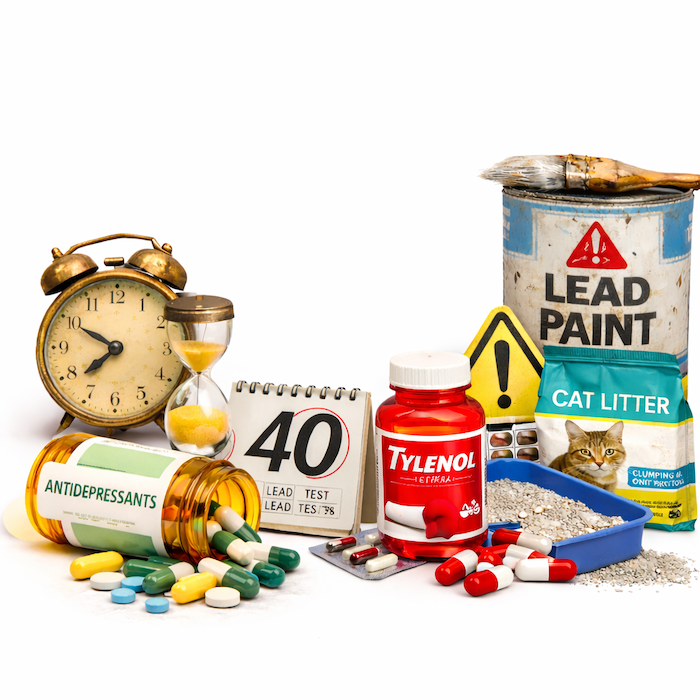
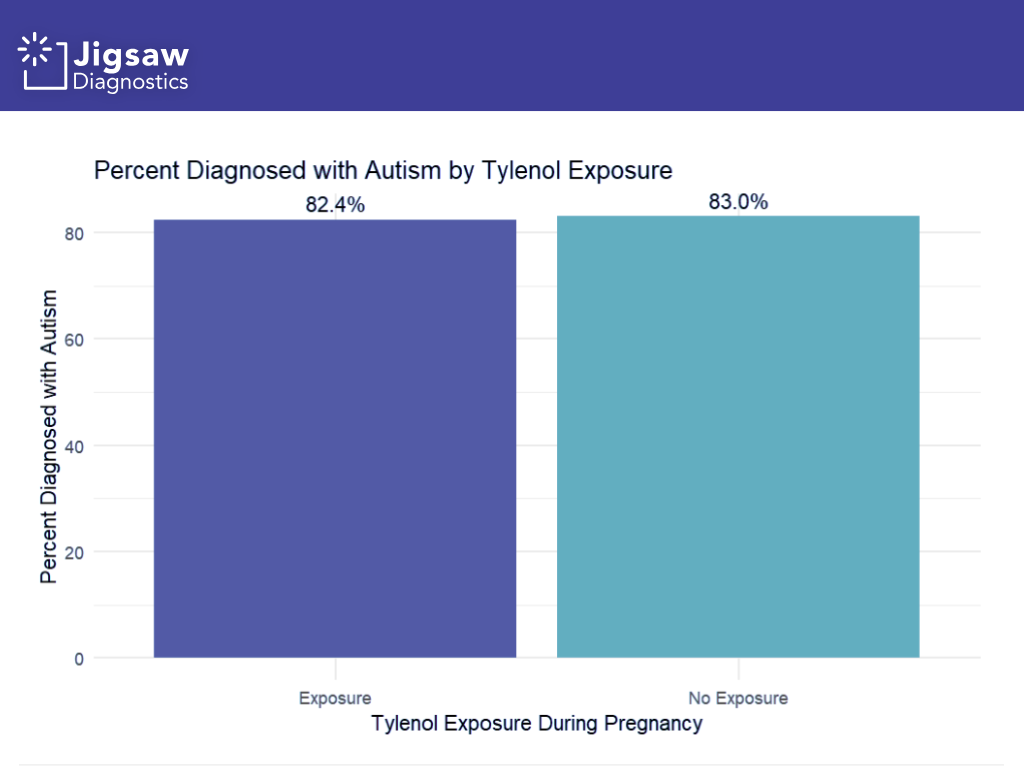
There is no single cause of autism. Both genetics and environmental factors may play a role. In part due to the recent increased national attention on the potential association between Tylenol and autism, Jigsaw Diagnostics took a retrospective review of about 2000 of its evaluations to look at several key prenatal factors. Namely, we looked at mother’s exposure to environmental toxins, such as lead7, nicotine4,5, and cat litter3,9; mother’s use of medications, including acetaminophen1,6 and antidepressants2,8; and age of parents at time of conception10.
This review is purely descriptive and does not have the power or statistical controls to provide evidence for any causal statements related to autism spectrum disorder.
In this clinically referred sample, 83% were diagnosed with autism and 17% with a different neurodevelopmental disorder. 70% were male and 30% female. The average age of first concern for the child’s development was about 2 ½ years old. Dads on average were 31 years old at the time of the child’s conception, and moms were 28 years old.
A comprehensive statistical analysis was performed to study the correlation of several demographic factors and prenatal exposures with a childhood autism diagnosis in this sample. Multiple approaches were used, including both standard multivariate logistic regression and mixed effects logistic regression to account for individual differences and relevant covariates.
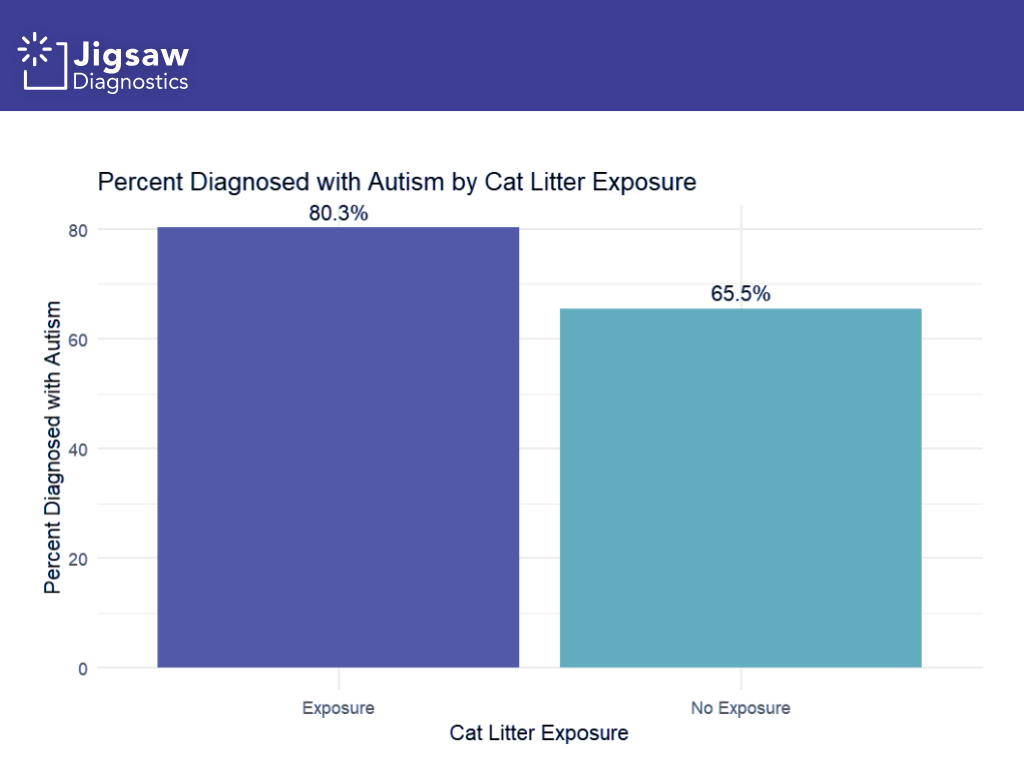
Among the variables examined, mother’s exposure to cat litter during pregnancy emerged as the only statistically significant predictor (p = 0.01). Despite this association reaching statistical significance, it’s important to mention that this analysis is not evidence of a large effect size. Essentially, cat litter exposure was correlated with a less than two-fold increase in the odds of diagnosis in our sample. In all, this indicates that exposure to cat litter alone is not a robust predictor of autism diagnosis. It is important to also emphasize that although logistic regression can unveil associations, it cannot determine causation nor constitute evidence of a large effect. Additionally, the potential biases in referral patterns and self-report also limit potential causal interpretation.
Cat litter exposure raises the risk that pregnant people may come into contact with a parasite commonly found in cat feces (toxoplasma gondii). If exposure happens during pregnancy (toxoplasmosis) there is a risk of potential fetal neurodevelopmental problems. No direct causal link between toxoplasmosis and autism has been firmly established, but multiple studies have found associations that raise the concern for developmental/behavioral/medical difficulties3,9. As such, individuals who may become or are pregnant are typically advised to avoid changing cat litter/protecting hands with gloves, and washing hands thoroughly.
.png)
Unlike claims made by Health & Human Secretary Robert F. Kennedy Jr. in the fall of 2025, our data can not conclusively rule in the possibility that Tylenol/acetaminophen plays a role in the development of autism spectrum disorder. Major medical organizations, including the American College of Obstetricians and Gynecologists (ACOG) and the World Health Organization (WHO), support the safety of Tylenol when used as directed during pregnancy. Our analysis remains descriptive and was not designed to determine causality. Given the complicated interplay of environmental, biological, and genetic factors in neurodevelopment, we cannot confirm or exclude any single variable, including acetaminophen, as a cause of ASD.
Jigsaw Diagnostics supports continued ongoing rigorous scientific research into both the causes as well as the best interventions and supports for autistic individuals across their lifespans. Moreover, according to the US Department of Health and Human services, maternal and infant health remains a substantial concern in the United States. Beyond the safety and efficacy of Tylenol for pregnant people, improved prenatal care is greatly needed, especially in communities where health disparities remain such as that of rural and in communities of color. It is crucial that pregnant individuals have access to accurate information, social support, and preventative resources; since a path to better outcomes lies in combining compassionate support with a commitment to equitable high-quality research. Empowering families, advancing autism science, and prioritizing maternal and infant health must be shared priorities on the journey toward a healthier future for all.
1Alemany, S., Avella-García, C., Liew, Z., García-Esteban, R., Inoue, K., Cadman, T., López-Vicente, M., González, L., Riaño Galán, I., Andiarena, A., Casas, M., Margetaki, K., Strandberg-Larsen, K., Lawlor, D. A., El Marroun, H., Tiemeier, H., Iñiguez, C., Tardón, A., Santa-Marina, L., … Sunyer, J. (2021). Prenatal and postnatal exposure to acetaminophen in relation to autism spectrum and attention-deficit and hyperactivity symptoms in childhood: Meta-analysis in six European population-based cohorts. European Journal of Epidemiology, 36(10), 993–1004. https://doi.org/10.1007/s10654-021-00754-4
2Brennan, P. A., Dunlop, A. L., Croen, L. A., Avalos, L. A., Salisbury, A. L., Hipwell, A. E., Nozadi, S. S., Sathyanarayana, S., Crum, R. M., Musci, R., Li, M., Li, X., Mansolf, M., O’Connor, T. G., Elliott, A. J., Ghildayal, N., Lin, P.-I. D., Sprowles, J. L. N., Stanford, J. B., … Paneth, N. (2022). Prenatal antidepressant exposures and autism spectrum disorder or traits: A retrospective, multi-cohort study. Research on Child and Adolescent Psychopathology, 51(4), 513–527. https://doi.org/10.1007/s10802-022-01000-5
3Galeh, T. M., Nayeri, T., Dodangeh, S., Hosseininejad, Z., Tanzif, A., Khalilian, A., & Daryani, A. (2025). Possible association between Toxoplasma gondii infection and autism spectrum disorder. Parasites, Hosts and Diseases, 63(3), 201–214. https://doi.org/10.3347/phd.24066
4Hertz‐Picciotto, I., Korrick, S. A., Ladd‐Acosta, C., Karagas, M. R., Lyall, K., Schmidt, R. J., Dunlop, A. L., Croen, L. A., Dabelea, D., Daniels, J. L., Duarte, C. S., Fallin, M. D., Karr, C. J., Lester, B., Leve, L. D., Li, Y., McGrath, M., Ning, X., Oken, E., … Musci, R. J. (2022). Maternal tobacco smoking and offspring autism spectrum disorder or traits in ECHO cohorts. Autism Research, 15(3), 551–569. https://doi.org/10.1002/aur.2665
5Kalkbrenner, A. E., Braun, J. M., Durkin, M. S., Maenner, M. J., Cunniff, C., Lee, L.-C., Pettygrove, S., Nicholas, J. S., & Daniels, J. L. (2012). Maternal smoking during pregnancy and the prevalence of autism spectrum disorders, using data from the autism and Developmental Disabilities Monitoring Network. Environmental Health Perspectives, 120(7), 1042–1048. https://doi.org/10.1289/ehp.1104556
6Khan, F. Y., Kabiraj, G., Ahmed, M. A., Adam, M., Mannuru, S. P., Ramesh, V., Shahzad, A., Chaduvula, P., & Khan, S. (2022). A systematic review of the link between autism spectrum disorder and acetaminophen: A mystery to resolve. Cureus. https://doi.org/10.7759/cureus.26995
7Kim JI, Lee DW, Lee YJ, Lee YA, Shin CH, Hong YC, Kim BN, Lim YH. Prenatal exposure to heavy metals and the trajectory of autistic traits in childhood. Environ Res. 2026 Jan 1;288(Pt 1):123269. doi: 10.1016/j.envres.2025.123269. Epub 2025 Nov 3. PMID: 41192613.
8Mathew, S., Bichenapally, S., Khachatryan, V., Muazzam, A., Hamal, C., Velugoti, L. S., Tabowei, G., Gaddipati, G. N., Mukhtar, M., Alzubaidee, M., Dwarampudi, R. S., & Alfonso, M. (2022). Role of serotonergic antidepressants in the development of Autism Spectrum Disorders: A systematic review. Cureus. https://doi.org/10.7759/cureus.28505
9Nayeri, T., Sarvi, S., Moosazadeh, M., Hosseininejad, Z., Sharif, M., Amouei, A., & Daryani, A. (2020). Relationship between toxoplasmosis and autism: A systematic review and meta-analysis. Microbial Pathogenesis, 147, 104434. https://doi.org/10.1016/j.micpath.2020.104434
10Wu, S., Wu, F., Ding, Y., Hou, J., Bi, J., & Zhang, Z. (2016). Advanced parental age and autism risk in children: A systematic review and meta‐analysis. Acta Psychiatrica Scandinavica, 135(1), 29–41. https://doi.org/10.1111/acps.12666